How to Break Through the 80 WPM Typing Plateau
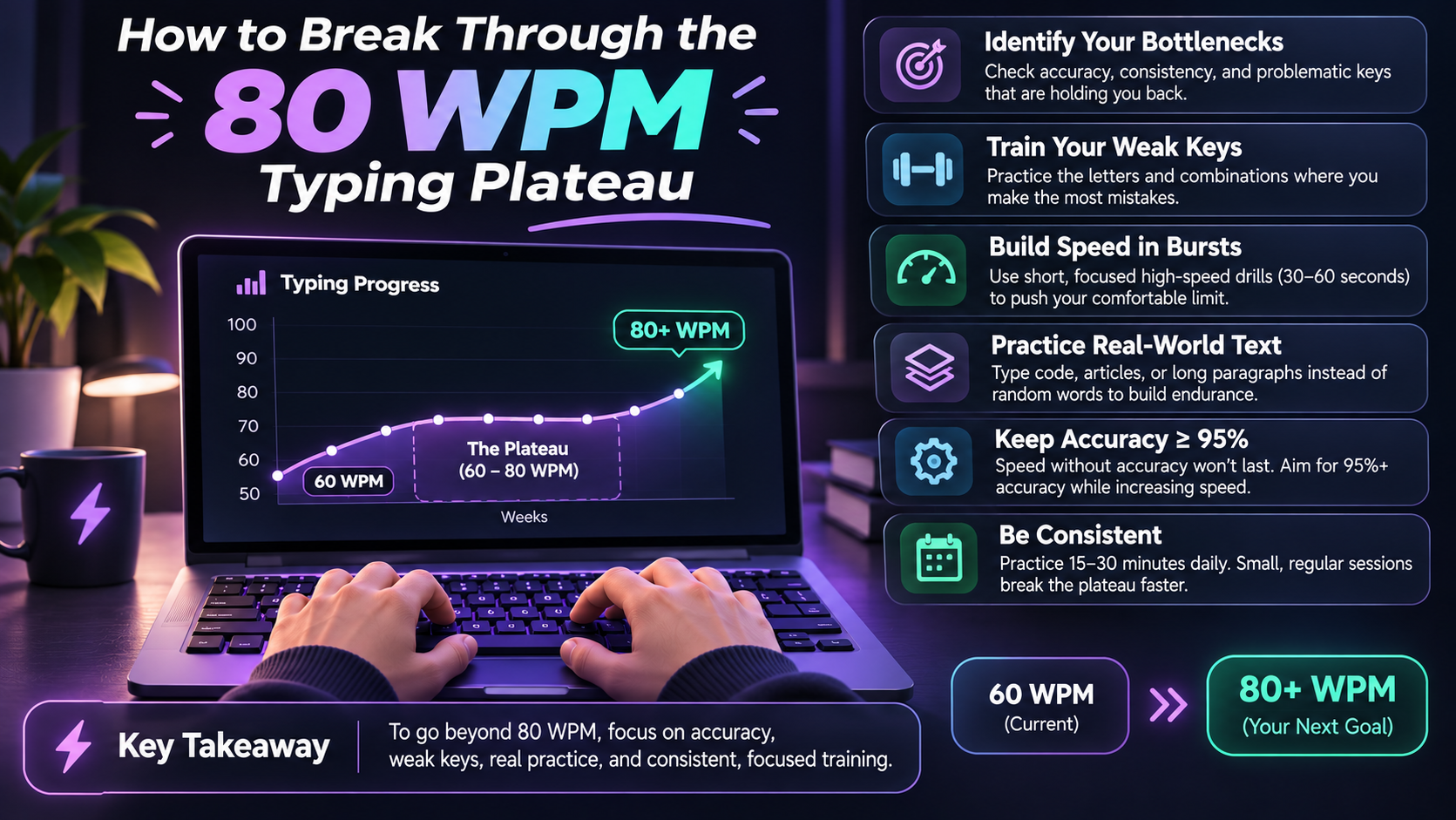
Table of Contents
- Why the 80 WPM Wall Exists
- 3 Drills to Shatter the 80 WPM Plateau
Why the 80 WPM Wall Exists
Most casual typists stop improving around 50 to 60 WPM. Those who practice consistently often hit a stubborn wall between 75 and 85 WPM.
At 75 WPM, your fingers are already dexterous. The bottleneck is no longer mechanical finger agility; it is how your brain processes visual text and queues motor commands.
When you type at 60 WPM, your mind reads letter by letter: *t-h-e-r-e-f-o-r-e*. To reach 100+ WPM, your brain must transition to lexical chunking—treating whole words and common prefixes as single, consolidated motor reflexes.
3 Drills to Shatter the 80 WPM Plateau
1. Train Your Eyes to Look Two Words Ahead
Amateur typists fixate their gaze directly on the letter their fingers are currently depressing. Fast typists look 2 to 4 words ahead of their active fingers. By buffering the next phrase in visual memory, your fingers transition across word spaces with zero micro-stuttering.
2. Practice High-Frequency N-Grams
English prose consists of repeated character clusters known as n-grams:
th, he, in, er, an, re, ndthe, and, ing, ent, ion, forDrill these sequences until the entire 3-letter sequence fires as one fluid rolling finger motion.
3. Deliberately Type 15 WPM Below Your Record
Take three 5-minute tests at 65 WPM with 100% accuracy. Focus on perfectly even rhythmic pacing between every keystroke. Removing panic and tension resets your neural motor pathways, enabling cleaner, faster bursts on your next speed run.
Sujal Kumar Soni
Founder & AuthorCreator and lead engineer of Kridha Type. Passionate about developer tooling, high-velocity typing mechanics, and helping engineers reach their peak cognitive flow state.
Put These Techniques to the Test
Track your exact words per minute, keystroke latency, and code accuracy on Kridha Type.
Recommended Reading
How to Increase Typing Speed for Coders: 10 Science-Backed Methods
Master touch typing tailored specifically for developers. Learn how practicing real JavaScript, React, and Python syntax builds muscle memory faster than generic dictionary tests.
Why WPM and Accuracy Matter for Software Engineers in 2026
Why typing rhythm directly impacts your cognitive flow state during complex programming, code reviews, and live technical interviews.
Mastering Special Symbols and Brackets in JavaScript and React JSX
Drill exercises for error-prone syntax symbols like curly braces, arrow functions, semicolons, triple equals, square brackets, and JSX props to eliminate typing bottlenecks.